

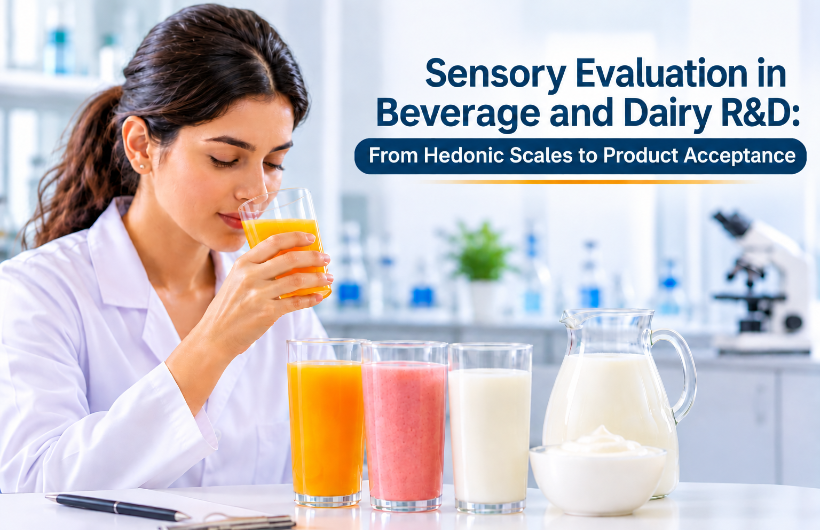
In beverage and dairy product development, a formulation may meet its nutritional, microbiological, and processing requirements, yet fail to deliver the sensory experience consumers expect. Taste, aroma, texture, appearance, and mouthfeel influence product acceptance and repeat consumption. For R&D teams, sensory evaluation provides a structured approach to assess these attributes, compare formulations, and make data-driven product development decisions.
1. What Is Sensory Evaluation?
Sensory evaluation is the systematic assessment of a product using human senses under controlled conditions. In beverage and dairy R&D, it helps identify differences between formulations, evaluate ingredient performance, monitor consistency, and determine consumer preferences.
The assessment may be conducted during initial formulation development, pilot trials, process optimisation, shelf-life studies, and pre-commercial validation. The choice of sensory method depends on the objective of the evaluation.
2. Understanding the 9-Point and 5-Point Hedonic Scales
Hedonic scales measure how much a consumer likes or dislikes a product. They are particularly useful when comparing different formulations or evaluating overall product acceptance.
9-Point Hedonic Scale
The 9-point hedonic scale ranges from Dislike Extremely to Like Extremely, with a neutral midpoint. It provides a relatively detailed measure of consumer liking and helps R&D teams identify subtle differences in product acceptance.
For example, when comparing three flavoured milk formulations, a panel may evaluate sweetness, flavour, mouthfeel, and overall liking. The resulting scores help identify which formulation performs best with the target consumers.
5-Point Hedonic Scale
The 5-point hedonic scale uses five response categories, typically ranging from Dislike Very Much to Like Very Much. It is simpler for respondents and can be useful in preliminary evaluations or situations where a shorter assessment is preferred.
While the 9-point scale offers greater response granularity, the 5-point scale provides a more straightforward evaluation. Neither scale is universally superior; selection depends on the study design, target panel, and level of discrimination required.
3. Other Sensory Parameters Used by R&D Teams
Beyond hedonic testing, R&D teams use additional methods to understand specific product characteristics.
• Appearance and Colour: Evaluates colour uniformity, opacity, visual appeal, sedimentation, and phase separation.
• Aroma and Flavour: Assesses characteristic notes, flavour intensity, off-notes, aftertaste, and flavour balance.
• Sweetness and Acidity: Examines perceived sweetness, sourness, and their balance in the overall flavour profile.
• Texture and Mouthfeel: Evaluates thickness, creaminess, smoothness, grittiness, astringency, and perceived body.
• Descriptive Sensory Analysis: Uses trained panellists to identify and quantify specific sensory attributes, creating a detailed product profile.
• Just-About-Right (JAR) Scales: Determines whether an attribute, such as sweetness or carbonation, is perceived as too low, ideal, or too high.
• Difference Testing: Methods such as triangle tests help determine whether consumers or panellists can detect a sensory difference between two products.
4. Making Sensory Data Useful for Product Development
Reliable sensory evaluation requires controlled sample preparation, consistent serving temperatures, randomised sample presentation, appropriate palate cleansers, and unbiased questioning. R&D teams should also select suitable panellists and use statistical analysis to interpret results.
Sensory findings become more valuable when correlated with measurable parameters such as pH, viscosity, soluble solids (°Brix), acidity, and instrumental colour. For example, changes in stabiliser concentration may influence viscosity and perceived creaminess, while variations in sweetener levels may affect sweetness perception and aftertaste.
Conclusion
Sensory evaluation is an essential part of beverage and dairy product development. From hedonic scales to descriptive analysis and difference testing, these methods help R&D teams understand consumer expectations, optimise formulations, and assess product consistency. When combined with analytical testing and pilot-scale validation, sensory insights support the development of products that perform technically while delivering the intended consumer experience.