

In food, dairy, and beverage manufacturing, a formulation that performs successfully in laboratory conditions does not automatically guarantee consistent results at commercial scale. Differences in equipment geometry, heat transfer, mixing efficiency, processing time, and filling conditions can significantly influence the final product. This makes pilot trials a critical stage between laboratory development and full-scale commercial production.
1. What Is a Pilot Trial?
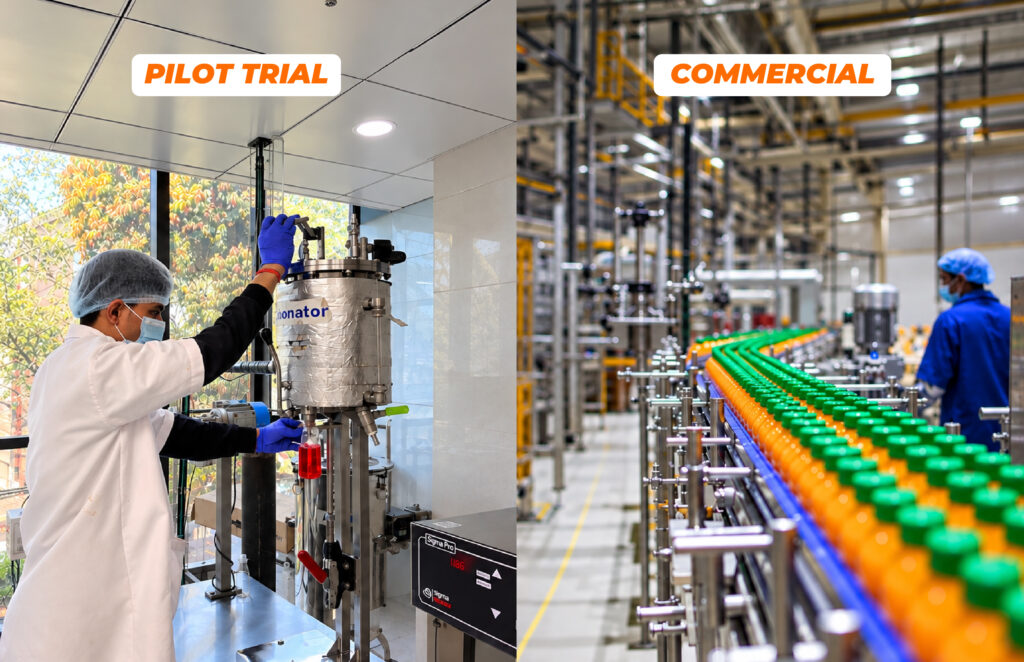
A pilot trial evaluates a product formulation and its processing parameters on a smaller production system that replicates key operating conditions of commercial manufacturing. It enables manufacturers to assess process feasibility, identify technical limitations, and establish preliminary operating parameters before committing to full-scale production.
During a pilot trial, critical parameters such as mixing speed, homogenisation pressure, processing temperature, holding time, viscosity, and filling behaviour can be evaluated. Depending on the product and process, trials may also assess ingredient dispersion, emulsion stability, heat-treatment performance, and physical changes during processing.
The objective is to understand how the formulation behaves under controlled processing conditions and determine whether the selected process can be scaled up reliably.
2. What Defines Commercial Production?
Commercial production involves manufacturing the product at the intended production capacity using industrial-scale equipment and an established process flow. At this stage, the focus shifts from process feasibility to operational consistency, throughput, quality control, and production efficiency.
Manufacturers must ensure that the equipment can maintain the required processing conditions at the target production rate. Parameters such as heating and cooling capacity, cleaning cycles, and filling line speed must be aligned with the overall production requirements.
Commercial production also requires defined operating procedures, quality-control checkpoints, validated processing conditions where applicable, and repeatable batch performance. Any variation in process parameters can affect product specifications, production yield, and shelf-life performance.
3. Key Technical Differences
Replace Section 3 with the following concise comparison table:
| Parameter | Pilot Trial | Commercial Production |
| Capacity | Small-scale | Industrial scale |
| Objective | Feasibility | Manufacturing |
| Process Control | Parameter testing | Process consistency |
| Equipment | Pilot systems (Minimum Quantity) | Production systems (Maximum Quantity) |
| Efficiency | Process optimisation | Operational efficiency |
| Validation | Scale-up assessment | Process validation |
| Output | Trial batches | Market-ready batches |
4. Why Pilot Trials Matter Before Commercialisation
Scaling directly from laboratory development to commercial production can introduce technical and operational risks. A formulation may behave differently when exposed to industrial mixing patterns, longer processing cycles, or different thermal conditions.
Pilot trials help manufacturers identify these risks before commercial commissioning. They provide practical insights into equipment selection, process sequencing, operating parameters, and potential modifications to the production line. They also support the assessment of product stability and filling compatibility under representative processing conditions.
However, pilot-scale success alone does not establish commercial readiness. Scale-up decisions must consider equipment design, process engineering, product specifications, and the requirements of the intended production system.
5. From Pilot Validation to Commercial Manufacturing
A structured scale-up approach connects product development with industrial production. By evaluating critical process parameters at pilot scale and translating the findings into equipment and process requirements, manufacturers can reduce uncertainty during commercial implementation.
The objective is not simply to reproduce the formulation at a larger volume, but to establish a process that consistently delivers the required product quality at the intended production capacity.
For food, dairy, and beverage manufacturers, the transition from pilot trial to commercial production is therefore an essential engineering stage in building reliable, scalable, and efficient manufacturing operations.